
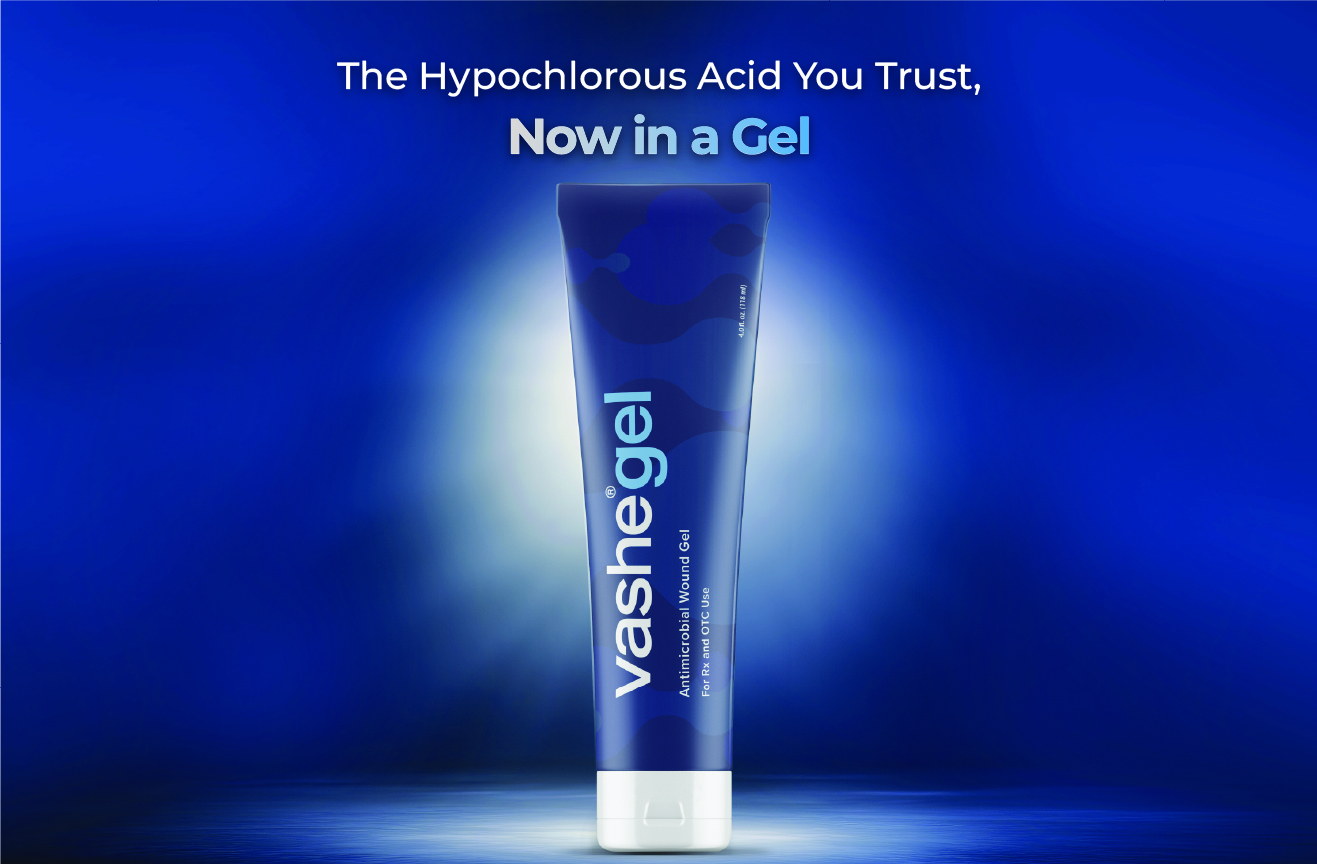
Introducing

Simple. Effective. Accessible.
Primary wound care products fall short in complex wound environments, often delivering singular benefits and forcing clinicians to combine multiple products to address basic healing needs. VasheGel not only delivers the singular benefits of other products, but its hypochlorous acid formulation enables it to perform far beyond:

Addresses bioburden
* Clarivate Market Share Data, Cleansers, June 2023
References: 1. Murphy C, Atkin L, Swanson T, Tachi M, Tan YK,Vega de Ceniga M, Weir D, Wolcott R. International consensus document. Defying hard-to-heal wounds with an early antibiofilm intervention strategy: wound hygiene. J Wound Care 2020; 29(Suppl3b):S1–28.2.EuropeanPressure Ulcer Advisory Panel, National Pressure Injury Advisory Panel and PanPacific Pressure Injury Alliance. Prevention and Treatment of PressureUlcers/Injuries: Clinical Practice Guideline. The International Guideline.Emily Haesler (Ed.).EPUAP/NPIAP/PPPIA: 2019.3.Eriksson, E,Liu, PY, Schultz, GS, et al. Chronic wounds: Treatment consensus. Wound RepReg. 2022; 30( 2): 156- 171.doi:10.1111/wrr.12994 4. International Wound Infection Institute(IWII) Wound Infection in Clinical Practice. Wounds International. 2022. 5. Nagoba BS, Suryawanshi NM, Wadher B, et al.Acidic environment and would healing: A review. Wounds. 2015;27(1):5-11. 6. Vermeulen H, van Hattem JM, Storm-Versloot MN, et al. Topical silver for treating infected wounds. Cochrane Database Syst Rev.2007;24(1):CD005486. 7. Gethin G. The significance of surface pH in chronic wounds. Wounds UK. 2007;3(3):52-56. 8. Hunt TK, Hopf HW. Wound healing and wound infection: What surgeons and anesthesiologists can do. SurgClin North Am. 1997;77(3):587-606. 9. Nagoba BS, Gandhi RC, Wadher BJ,et al. Microbiological, histopathological and clinical changes in chronic wounds after citric acid treatment. J Med Microbiol. 2008;57(5):681-682. 10. Thomas S. Wound Management and Dressings. London, UK: Pharmaceutical Press;1990. 11. Molan PC. Re-introducing honey in the management of wounds and ulcers-theory and practice. Ostomy Wound Manage. 2002;48(11):28-40. 12. Ortega-Peña, Silvestre & Hidalgo-González, Christian & Robson, Martin& Krötzsch, Edgar. (2016). In vitro microbicidal, anti-biofilm andcytotoxic effects of different commercial antiseptics: Antibiofilm effects of different commercial antiseptics. International Wound Journal. 14.10.1111/iwj.12625. 13. Malone M., Bjarnsholt T., McBain A.J., JamesG.A., Stoodley P., Leaper D., Tachi M., Schultz G., Swanson T., Wolcott R.D.The prevalence of biofilms in chronic wounds: A systematic review and meta-analysis of published data. J. Wound Care. 2017; 26:20–25. doi: 10.12968/jowc.2017.26.1.20 14. Mendoza R.A., Hsieh J.-C., Galiano R.D.Wound Healing—Current Perspectives. Intech Open; London, UK: 2019. The Impact of Biofilm Formation on Wound Healing. 15. Percival SL, Vuotto C,Donelli G, Lipsky BA. Biofilms and wounds: an identification algorithm and potential treatment options. Adv Wound Care (New Rochelle). 2015;4(7):389-397. 16. James GA, Swogger E, Wolcott R, et al. Biofilms in chronic wounds. Wound Repair Regen. 2008;16(1):37-44. doi: 10.1111/j.1524-475X.2007.00321.x. 17. Robson MC. Treating chronic wounds with hypochlorous acid disrupts biofilm. Today’s Wound Clinic. 2014;8(9). 18. Block SS. Disinfection, sterilization, and preservation. Philadelphia: Lea & Febiger; 2000. 19. Wang L, Bassiri M, Najafi R, et al: Hypochlorous acid as a potential wound care agent: Part I. Stabilized hypochlorous acid: A component of the inorganic armamentarium of innate immunity. J Burns Wounds. 2007; 6:65-79. 20. Vashe Wound Solution data developed from USP 51 Antimicrobial testing. 21. Bohn GA, Champion S, Eldridge K. Can the use of hypochlorous acid change your dressing selection? Poster Presentation: Symposium for Advanced Wound Care;2013; Orlando, FL. 22. Nerandzic MM, Rackaityte E, Jury LA, et al. Novel Strategies for Enhanced Removal of Persistent Bacillusanthracis Surrogates and Clostridium difficile Spores from Skin. PLoS One. 2013;8(7):e68706. doi:10.1371/journal.pone.0068706. 23. Data on file with Urgo Medical North America. 24. Niezgoda JA, Niezgoda JA, Niezgoda KM, Mallow PJ. Cost-per-Response Analysis of Pure Hypochlorous Acid Among Patients with Chronic Venous Leg Ulcers: A Health Economic Analysis. Adv Skin Wound Care. 2023 Nov 1;36(11):587-590. doi: 10.1097/ASW.0000000000000024. Epub 2023 Aug 24. PMID: 37682298. 25. Gallagher KE, Alberto EC,Mallow PJ, Hermans MH, Cardenas L. A Retrospective Health Economic Analysis of a Stable Hypochlorous Acid Preserved Wound Cleanser Versus 0.9% Saline Solution as Instillation for Negative-Pressure Wound Therapy in Severe and InfectedWounds. Cureus. 2022 Apr 20;14(4):e24321. doi: 10.7759/cureus.24321. PMID:35607546; PMCID: PMC9123387. 26. Mallow PJ, Hiebert JM, Robson MC.Cost-Effectiveness of Hypochlorous Acid Preserved Wound Cleanser versus SalineIrrigation in Conjunction with Ultrasonic Debridement for Complex Wounds.JHEOR. 2021;8(2):76-81. doi:10.36469/001c.28429. 27. Miller C, Mouhlas A. Significant cost savings realized by changing debridement protocol. Ostomy Wound Manage. 2014;60(9):8-9